
I’ve had a complicated relationship with exercise my whole adult life. Get motivated, start something, stick with it for a while, fall off. Repeat. For years that was the cycle.
Before February 2025 I actually had a solid plan laid out. Bodyweight training, Zone 2 cardio, Japanese radio exercises, eventually working up to VO2 max training. I’d done my research. I was ready to commit.
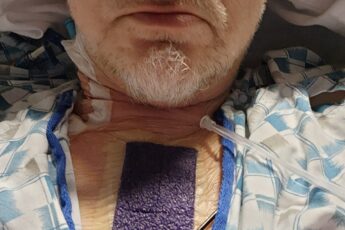
Then my stress test came back wrong. Twelve days later I was on an operating table getting three vessels bypassed.
The plan changed.
Starting Over From Zero
When I came home from the hospital, the only thing I could do was walk. Slowly. With someone nearby just in case. Getting from the bedroom to the kitchen was an event. That was my reality in February and March of 2025.
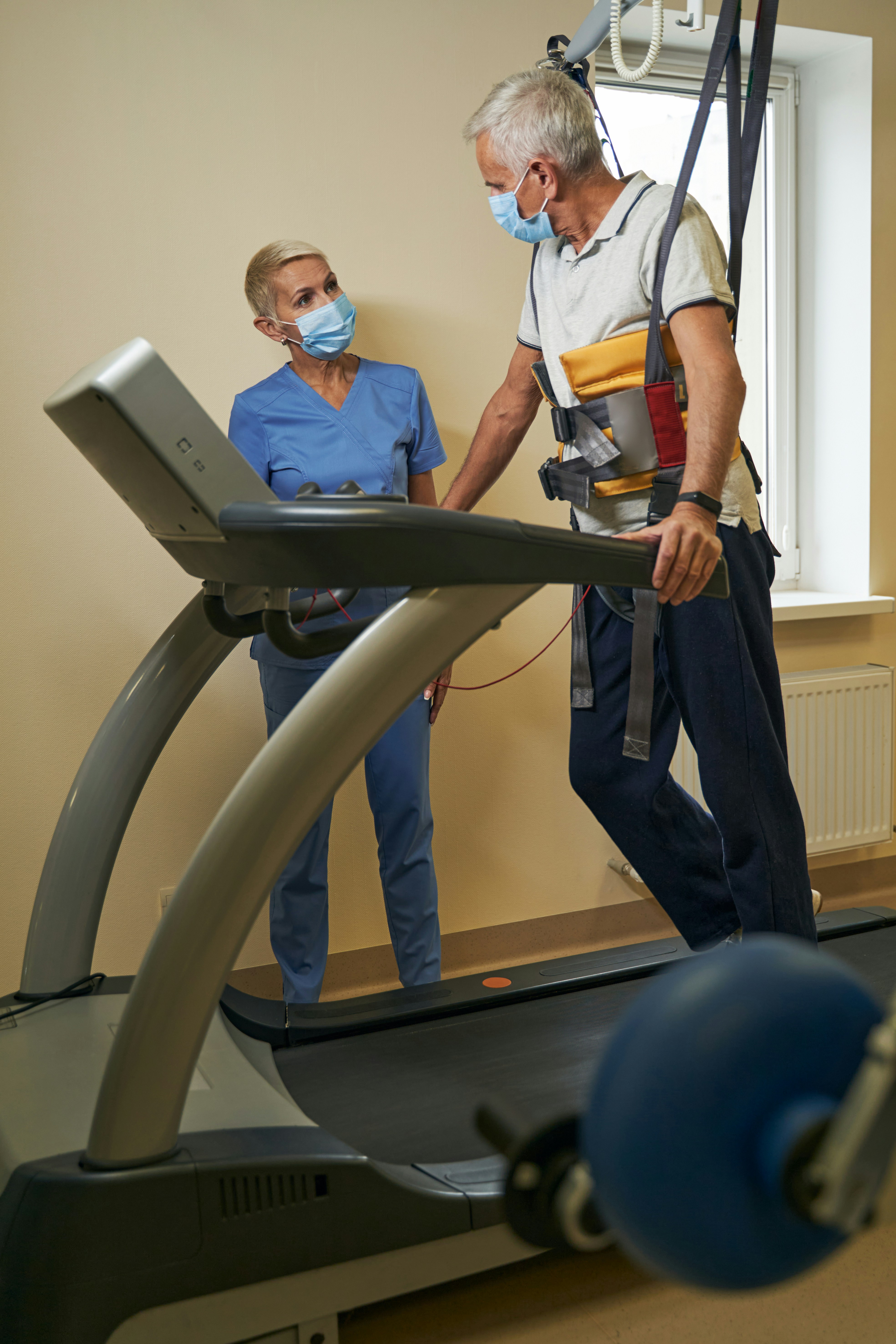
Cardiac rehab started April 14th — about eight weeks post-surgery. My first session on the treadmill was six minutes at 1.5 miles per hour. That’s barely moving. I knew it. The therapists knew it. But it was all I had and I showed up three times a week and did it anyway.
By the end of those five weeks I was doing ten minutes at 3.2 mph. Not fast by any measure. But I remembered where I started and it felt like a long way from there.
Something else happened in those sessions that I didn’t expect. My head cleared. The anxiety I’d been carrying since surgery started to ease up. I left every single rehab session feeling better than when I walked in. Every time. That surprised me more than the physical progress did.
(Click here to read my post of my decision to start over in life, Starting Over after 50 .)
How I Think About Exercise Now
Everything shifted after surgery. I’m not trying to hit numbers or chase goals the way I used to. I’m trying to stay alive and feel good doing it. Those are different motivations and they lead to different choices.
I stay mindful of how I feel. I don’t push hard just to push hard. My doctors cleared me for regular exercise after rehab but I earned a certain kind of caution and I’m keeping it.
Three days a week is my floor. That’s what I’m working toward and working to protect.
Now in my 50s, I’ve realized that taking care of my body is no longer optional. Recovering from setbacks — like major surgery or falling off an exercise routine — takes longer than it did in my 20s and 30s. Time feels more precious. The wear and tear is more noticeable. But that also makes every healthy choice feel more meaningful. Like an investment in years I actually want to live well.
Warm-Up: Rajio Taiso
I kept this from my original plan and I’m glad I did.
Rajio Taiso is a Japanese radio exercise routine — short, guided, built around gentle joint movement, stretching, and circulation. It’s been broadcast on Japanese radio for decades. The movements are designed to be done by everyone regardless of age or fitness level, and they flow together at a steady, unhurried tempo.
I use it as my warm-up before anything else. On low-energy days sometimes it’s the only formal exercise I do — and I’ve made peace with that. Something is always better than nothing, and this is something I can always do.
What the routine covers:
- Arm and shoulder circles — loosening the joints, getting blood moving
- Torso twists — gentle rotation through the mid-section
- Side bends — lateral stretch through the lats and obliques
- Leg swings and knee raises — warming up the hips and legs
- Gentle back extension — counteracting all the forward bending we do
I follow along with YouTube videos — search “Rajio Taiso” and there are plenty of good options, some with English subtitles. Feet shoulder-width apart, knees soft, just follow the music. Three minutes. That’s it.
How I do it:
- I follow along with YouTube videos — search “Rajio Taiso” and there are plenty of options, some with English subtitles. I’ll link the ones I use below.
- Stand feet about shoulder-width apart, knees soft, posture upright
- Let the music guide the timing — the exercises start and stop with the musical cues
- Focus on range of motion, not intensity — the goal is to loosen up, not strain
- If a particular movement feels tight, I only go as far as is comfortable. The range naturally improves over time.
- Repeat often enough and the sequence gets into muscle memory — I barely have to watch the video anymore
→ Rajio Taiso video 1 → Rajio Taiso video 2 → Rajio Taiso video 3
Each session is around three minutes. I’ve done it enough times now that I know most of the sequence without having to watch closely. Repetition made it second nature.
Bodyweight Training
When I first decided to lose weight years ago after quitting smoking, I had no gym access and no equipment. Calisthenics became my go-to because they were simple, flexible, and I could do them anywhere. I’m using the same foundation now, just building back up from a much lower starting point than before.
The goal of bodyweight training for me isn’t about looking a certain way. It’s about being functionally strong — capable, stable, able to do the things I want to do without the body giving out on me.

Before surgery I had a full routine planned. I still want all of it. I’m just getting there slowly.
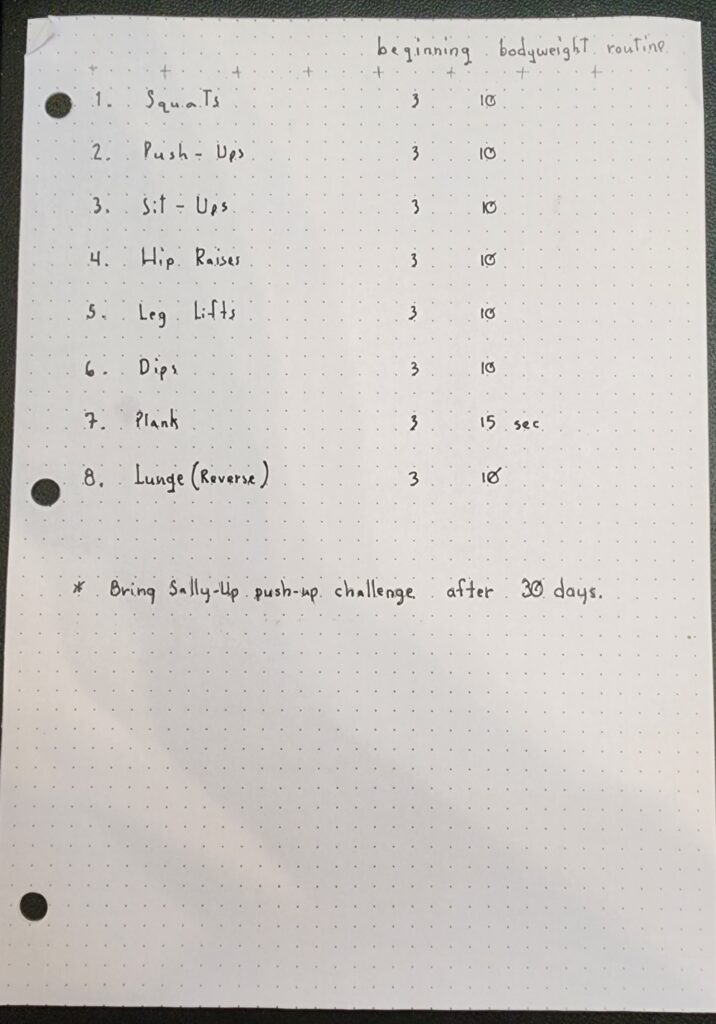
What I’m doing right now — modified versions:
- Wall push-ups (working toward floor push-ups)
- Partial squats
- Short planks
- Hip raises / glute bridges
- Leg lifts
- Sit-ups
Still on the list — further down the road:
- Full push-ups
- Dips
- Lunges
- Pull-ups
- Bring Sally Up challenge (someday)
How I’m progressing: I started with just a few reps of each, once through. As things get easier I add reps, then sets. I’m not rushing it. I rushed things before and paid for it with injuries. This time I’m building slowly and staying consistent over the long run.
- Squats: Great for legs and glutes. Start with shallow squats and gradually go deeper.
- Push-Ups (or Incline Push-Ups): Ideal for upper body and core. Beginners can start against a wall or use a table edge.
- Sit-Ups: Focuses on strengthening your abdominal muscles.
- Hip Raises (Glute Bridges): Strengthen the posterior chain and can help relieve lower back tension.
- Leg Lifts: Targets your lower abs and hip flexors.
- Dips: Helps strengthen your triceps, chest, and shoulders.
- Planks: Core stability exercise that helps improve posture and reduce lower back strain. Begin with short 10-20 second holds and increase as it gets easier.
- Lunges: Great for building strength & stability in your legs and glutes.
Progressing Over Time:
- Beginner Level: Maybe just 5 reps per exercise, once or twice through.
- After a Few Weeks: Increase to 10 reps, and then to multiple sets. I once struggled with proper-form push-ups, so I began with a modified form and built up slowly.
- Long-Term Goal: Eventually, I’d like to try the “Bring Sally Up” challenge as a fun milestone. Also, I will eventually start working in pull-ups, but that will be awhile I think. Have to see how my strength builds.
Cardio
Walking
Walking is still my primary cardio. My job keeps me on my feet from 5am to 2pm five days a week, so there’s already a base of low-intensity movement built in whether I plan for it or not. That’s actually a real advantage — I’m never starting completely cold.
Outside of work I try to get intentional walks in on top of that — not just steps that happen because I’m on the clock, but deliberate movement with some purpose behind it. Brisk enough to feel it, not so hard I’m pushing anything I shouldn’t be pushing right now.
Zone 2 is what I aim for — keeping my heart rate in that 60–70% range. It’s the zone where I’m working but not straining, building aerobic capacity without overtaxing the system. I’ve learned what that actually feels like for me now, and I try to stay there. If things get too easy I might look at wearing a light rucksack at work or spending longer on the bike for extra challenge down the road.
The rule I live by now: if something feels off, I stop. I don’t push through it. That wasn’t always how I operated, but it is now.
The Exercise Bike
I have an exercise bike at home and it’s doing double duty for me right now.
On the cardio side, it’s low-resistance steady-state riding — building duration before I think about intensity. Short sessions at a comfortable pace, just keeping the cardiovascular system working without pushing the heart harder than it needs to be pushed at this stage.
But the other reason I use it is my knees. My flexibility and balance have declined noticeably over the past few years — both, and faster than I expected. The bike gives me low-impact movement that lubricates and gently strengthens the knee joints without the pounding that other exercise would cause. These sessions aren’t about heart rate or calories. They’re about keeping the knees moving comfortably and reducing the stiffness and pain that comes when I’m sedentary. It’s been good for that.
Right now I’m building duration before I even think about intensity. If things progress well and my heart responds, I may look at adding short higher-intensity intervals eventually — Zone 5 work to improve VO2 max. But that’s a long way out from where I am. Steady and consistent is the plan for now.
Listening and Adapting
If my knees act up or fatigue sets in, I scale back. Consistency matters, but not at the expense of injury or burnout. By staying flexible and paying attention, I can keep moving forward without the setbacks that come from pushing too hard too soon. I’ve had enough of those.
Flexibility and Balance
I’ve noticed a loss in flexibility and balance compared to my younger years. Improving these areas will help prevent injury and make everything else feel smoother.
Stretching
I do post-exercise stretching after every session — hamstrings, calves, chest, shoulders, holding each one around 20–30 seconds. Nothing dramatic, but I notice the difference on the days I skip it. The body tightens up faster in your 50s than it ever did before, and I’ve felt what it’s like when flexibility just disappears. I’m not going back to that.
I already have a stretching routine put together, and I’ll keep adding to it as I learn what works for me.
Balance
Balance work matters more to me now than it ever did. I tracked 14 dizziness and balance episodes last year and that got my attention in a way that was hard to ignore. In the past I’d been reasonably good with my balance — for some reason lately it’s declined along with my flexibility, and both faster than I expected.
What I’m doing for balance:
- Single-leg stands — near a wall for safety, working up to holding without support
- Heel-to-toe walks — slow and deliberate, focuses the mind as much as the body
- Side leg raises — hip strength and lateral stability
Tai Chi and Yoga
Both are still on my radar. Low-impact, good for balance, good for the nervous system, and good for the mind. I have a small yoga set already and I’ve started looking into how practical it is to learn Tai Chi at home. Haven’t built either into a regular routine yet — partly timing, partly just finding the right entry point. But they’re in the plan. I haven’t given up on them.
My Schedule
I work Wednesday through Sunday, 5am to 2pm. Monday and Tuesday are my days off. Most of my structured exercise happens on those days off, or in the evenings after work when I have energy left.
How the week typically breaks down:
- Monday (day off): Primary workout — bodyweight + intentional walk or bike session
- Tuesday (day off): Second workout — mix it up depending on how the body feels
- Wednesday–Sunday (work days): On my feet 5am–2pm already. Evenings when energy allows — sometimes Rajio Taiso is all I’ve got and that’s okay.
- Target: 3 sessions per week minimum
I don’t spiral when a week goes sideways. One bad week doesn’t undo the work before it. Consistency across the month is what matters, not perfection in any single week.
Where I Am With It
Almost a year out from surgery. The goal for 2026 is simple: exercise three times a week, keep my heart healthy, and slowly rebuild the strength I lost during seven months away from work.
Some weeks I hit it. Some I don’t. What I’ve noticed is that the weeks I treat exercise like an appointment I can’t cancel are the weeks it actually happens. The weeks I leave it open-ended are the weeks it disappears into everything else.
I’m not training for anything dramatic. I’m just trying to be around for a long time.
Turns out that’s enough to keep showing up.
This is my personal experience — not medical advice.
What I learned:
- I learned that showing up at 1.5 mph still counts
- I learned that my mental health is directly tied to whether I’m moving my body
- I learned that “modified” doesn’t mean failure — it means I’m still doing it
- I learned that consistency over months matters more than any single hard session
Related posts: → My Cardiac Rehab experience → My Triple Bypass story → Creating a Healthy Lifestyle



Leave a Comment